MEMORANDUM OF OBJECTS AND REASONS
Statement of the Objects and Reasons for the Bill:
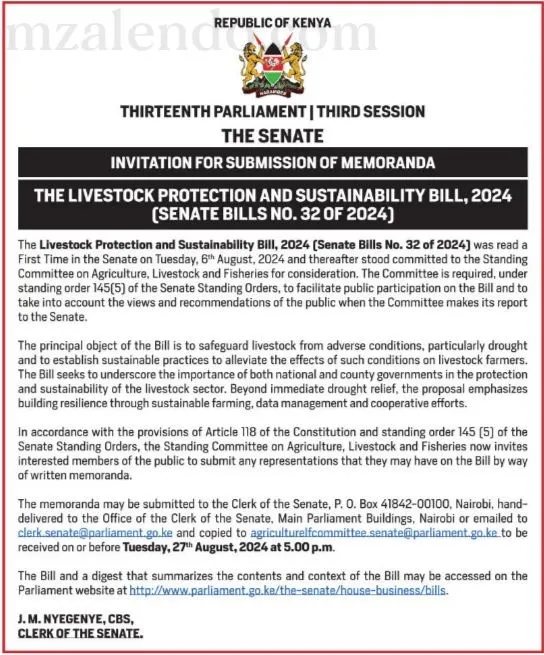
— The Bill aims to create a legal framework to promote the resilience of the livestock sector against drought and other risks. It emphasizes both protection and sustainable development of the livestock sector, which is crucial to the national and county economies.
PART I — PRELIMINARY
1. Short title:
This Act may be cited as the Livestock Protection and Sustainability Act, 2024.
2. Interpretation:
Defines key terms used within the Act such as “county executive committee member,” “disaster,” “drought,” “fodder banks,” “livestock,” “livestock feed,” “livestock product,” and others. These definitions are essential for understanding the scope and application of the Act.
PART II — ROLES OF THE NATIONAL AND COUNTY GOVERNMENTS
3. Roles of the National Government:
— The Cabinet Secretary is tasked with formulating national policies on livestock management, disaster mitigation, and feed reserve strategies. It also includes the establishment of the National Livestock Feed Reserve and collaboration with counties to set standards for pasture, water management, and conservation of natural resources.
4. Roles of County Governments:
— The county executive committee members are responsible for developing and implementing strategies to protect livestock from diseases, disasters, and other potential threats. They must also promote sustainable livestock farming practices, monitor feed risks, establish livestock feed reserves, and collaborate with local stakeholders and the national government.
PART III — LIVESTOCK PROTECTION AND SUSTAINABILITY MEASURES
5. Feeds Risk Management System:
— The Cabinet Secretary, in consultation with the Council of County Governors, is to develop and maintain a feeds risk data management system. This system should collect and store data, assess feed risks, and provide timely information to stakeholders.
6. National Livestock Feeds Reserve:
— Establishes a physical and financial reserve of livestock feed. The objective is to provide emergency feed supply during drought, mitigate food shortages and price volatility, and promote the efficient use of feed resources.
7. County Drought Resilience Plan:
— Requires each county to develop a resilience plan that includes a comprehensive assessment of drought vulnerability, resilience strategies, and a monitoring framework. Counties must allocate at least 0.5% of their annual budget to this plan.
PART IV — COUNTY LIVESTOCK ENTERPRISE DEVELOPMENT FUND
8. Establishment of the Fund:
— Counties where livestock farming significantly contributes to the local economy must establish a County Livestock Enterprise Development Fund. The fund will be financed through county appropriations, income generated from the fund, and other contributions.
9. Purpose of the Fund:
— The fund will support the establishment and management of livestock feed reserves, provide grants for emergency interventions, and offer loans to livestock owners and related enterprises.
10. Criteria for Establishment of the Fund:
— The Cabinet Secretary, in consultation with the Council of County Governors, will develop criteria to determine the significance of livestock farming to a county’s economy. Counties will refine these criteria to suit local needs.
PART V — MISCELLANEOUS PROVISIONS
11. Regulations:
— The Cabinet Secretary may, in consultation with the Council of County Governors, make regulations for the better carrying out of the Act. This includes the management of the National Livestock Feeds Reserve and related operations.
3 Comments
This is exactly what i was looking for, thank you so much for these tutorials
It would be great to try this theme for my businesses
What a nice article. It keeps me reading more and more!