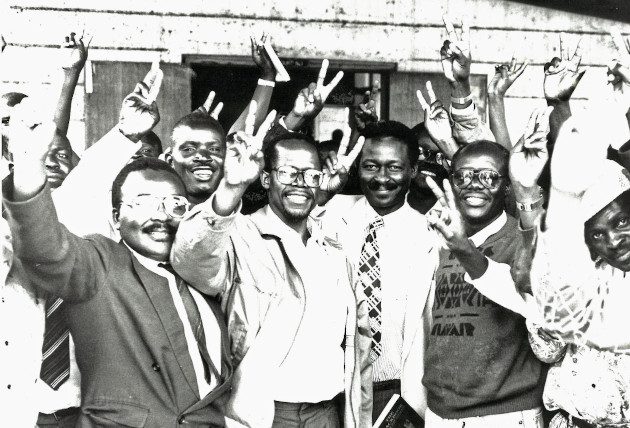
Historically, the youth have been the vanguard of democratic defiance, instrumental in dismantling systems of oppression and injustice. Universities were breeding grounds for thinkers, skeptics, analysts and dreamers alike, ideas were hatched, theories examined and philosophies were debated. Social movements began and came of age on campus and revolutions found their way beyond the walls of school.
Kenya’s history from the 1970s all through to the 1990s is replete with spirited protest and resistance against oppression in the form of student activism. Politics was part and parcel of university life, with students engaged in the national discourse. Students were proactive in campaigning for their rights and those of fellow Kenyans.
For instance, in 1972 when a student was knocked down along Uhuru Highway, students of the University of Nairobi held demonstrations and demanded the government to construct an underpass.
And when the death of Josiah Mwangi “JM’ Kariuki, member of parliament for Nyandarua North, made news in March 1975, students vented their anger on the streets. Students boycotted lectures and held demonstrations for five days inside and outside the University.
In December 1977 Ngugi wa Thiongo, then chairman of the University of Nairobi’s literature department was arrested and detained without charge at Kamiti Maximum Security Prison. Students’ protest against the detention gave power to the force pushing for Ngugi’s release. Ngugi was set free a year later on 12 December 1978.
The history of Kenya’s Second Liberation is also not complete without mention of the youth. When the fight for multiparty democracy in Kenya was at its peak, student activism and youth formations were instrumental in expanding the national democratic space.
The Young Turks, who fought tenaciously against the Moi autocracy, delivering Kenya’s second liberation, consisted mainly of young blood who coalesced behind seasoned political figures such as Kenneth Matiba, Oginga Odinga and Masinde Muliro to form the Forum for the Restoration of Democracy (FORD). The struggle successfully saw the repeal of the Section 2A of the Kenyan Constitution, ushering in the era of multiparty democracy.
Much has changed since then. Youth involvement in national affairs has been on a steady decline.
Statistically, the youth account for more than half of the Kenyan population. However, the proactive participation of youths in politics has over the years faltered.
During 2022 general election when the Independent Electoral and Boundaries Commission (IEBC) published the audit report of the voter register, the total youth that registered compared to 2017 and 2013 had declined significantly. The youth aged 18–34 accounted for only 39.4% of the 22 million registered voters.
Similarly, candidates gazetted for the August 9 polls attracted very few candidates. Of the 16, 099 candidates cleared for the election by the IEBC, those aged 35 years and below were only 4,508 while those above 35 years were 11,592. The lack of youthful energy was equally reflected in the membership of political parties. None of the main political formations had young people as part of their senior-most leadership.
This disconnect persists despite the promise of the 2010 Constitution, which introduced a devolved system of governance, to bring abundant opportunities especially for young people to participate in governance. But years on, both county and national politics are still a preserve of the old guard.
In 2013 and 2017, the Jubilee government ran on a youth-driven ticket, a government for the youth by the youth. Their agenda was to unlock the potential of the youth in Kenya. But in their ten years of power, they have a solid track record of breaking their manifesto pledges and not forgetting the numerous corruption cases that have stained the administration. Essentially the youth are the vehicle on which politicians ride to their promised destination but have no stake in the country’s politics.
But worse has been the approach to the ‘problem of youth participation,’ which is much rather condescending and chastising. The groove typically entails enticing young people by dressing like them, speaking like them, and hopping into their spaces (social media) without necessarily lending an ear to their problems. Politicians try to convert the youth to the political gospel using their stale political processes and ideologies. They do not take into account opinions and actions expressed by young people. Politics transcend the ballot and sip into everyday governance. Many politicians fail to consider this when looking to attract more young voters. Continuous voting with no change in the daily lives of young people is pointless.
Expecting no change, the youth have learnt to flip the script. In June 2022, BBC featured the story of Diana Mwazi, a young woman who mobilized crowds for pay at campaign rallies but openly declared that she would not be voting in the election. For many like Diana, abstaining from politics has become a form of protest—a bold middle finger to the political establishment that continues to sideline their voices and aspirations.
In the Zambia election in 2021, young people accounted for more than half of the registered voters and recorded the highest voter turnout in the election. The youth who had been angered by the leadership of former President Edgar Lungu rallied behind the incumbent Hakainde Hichilema, securing him a win in the polls. The Zambia election dispelled the myth that young people are not interested in politics.
It is time for the political class to wake up to the reality that, with the rapidly growing youth population, young people will soon hold the upper hand. Politicians must start giving them the attention they deserve. The demands of the youth are clear: they want a fundamental shift in the substance of the political agenda, its spheres, and its approach. Without such a transformation, the disconnect between leaders and the younger generation will only deepen.